The Content Nervous System: A New Framework for Answer-Led Journeys

Are your buyers reading your content, or are they just looking for answers?
This was the central question of our latest webinar featuring Andrey Kastelmacher, our own Sales Director. We explored the rapid transition toward “answer-led” journeys, where buyers leverage AI to research vendors without ever speaking to a human. To navigate this new reality defined by GEO (Generative Engine Optimization) and LLMs, we need a new approach. It’s no longer enough to just publish pages; we must build systems capable of satisfying the modern buyer’s demand for instant, accurate information.
The Rise of Generative Engine Optimization (GEO) and Answer-Led Journeys
The traditional buyer journey involved reading page after page to build a mental map of a solution. Today, that journey is being replaced by prompts and answers. Buyers are using LLMs to shortlist vendors before they ever speak to a human. This brings us to Generative Engine Optimization (GEO).
GEO isn’t just about how you appear on ChatGPT or Perplexity; it starts with your own website. If your site cannot deliver precise, high-quality answers to specific questions, external engines won’t be able to either. Buyers are conducting deep research in a “question-based engine” outside of our control. To stay relevant, we must ensure our content infrastructure is optimized to feed these engines with accurate, proof-based answers, not just marketing fluff.
Introducing the Content Nervous System (CNS)
To support this new journey, we need to stop thinking about tools in silos—chatbots, knowledge bases, and personalization engines—and start thinking biologically. We are introducing the Content Nervous System (CNS). In biology, the central nervous system takes inputs, processes them, and drives decisions. Your GTM strategy needs a similar brain.
A CNS acts as a single source of truth that unifies your content with buying signals. Unlike a standard rule-based chatbot designed only to book meetings, a CNS understands the context of the buyer. Take this use case for example: the CNS can empower sales teams by allowing anonymous visitors to ask technical questions without de-anonymizing too early. This gives your revenue team a “front-row seat” to what the buyer actually cares about, translating content consumption into tangible pipeline outcomes.
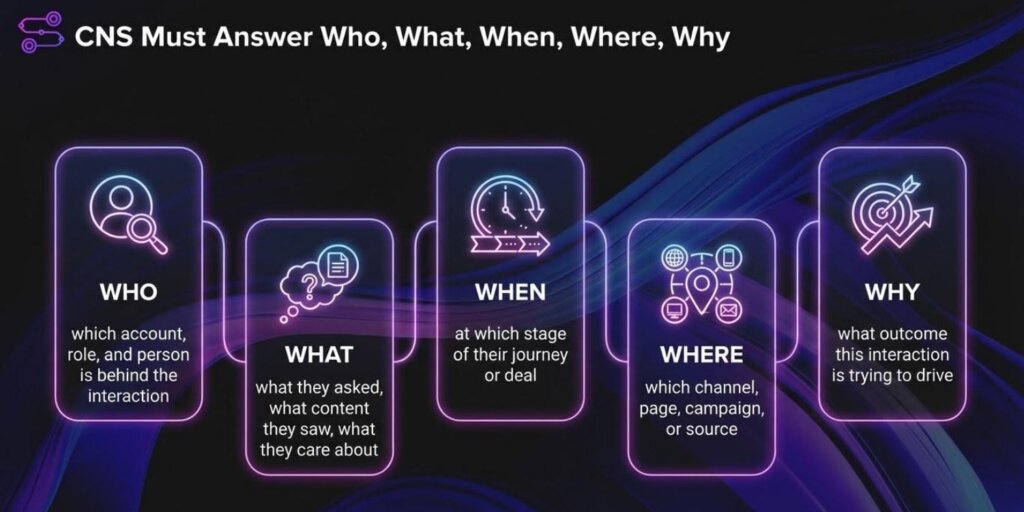
The Q&A Pair: The New Signal for Success
For years we obsessed over pageviews and time-on-site. However, in an answer-led world, the Q&A pair is the ultimate intent signal. When a visitor actively asks a specific question, it reveals significantly more about their intent and stage in the buying cycle than a passive pageview ever could. This is a game-changer for Sales teams. Instead of guessing a prospect’s pain points based on the pages they visited, a CNS provides the exact questions they asked during their anonymous research phase. Furthermore, for these answers to be effective, they must be rooted in proof. LLMs love evidence. If your content lacks case studies, data, and validation, the answers generated—whether by your onsite agent or an external LLM—will fall flat.
Watch the Full Discussion
Want to explore real-world use cases for using a CNS? Watch the full webinar and review the slides to see how this framework applies to your GTM strategy.
View the webinar slides here.
Watch the full webinar recording: