Agentic GTM: Build for the New B2B Buyer Journey
B2B buyer journeys have changed more in the last two years than in the decades before. What used to be a longer, multi-touch process is now happening much faster, more compressed, and far harder to observe. AI didn’t just introduce new tools—it changed buyer behavior. And that shift demands a new operating model: Agentic GTM, supported by agentic websites that can guide buyers through decision-making in real time.
What Changed in Buyer Journeys
Not long ago, the buying process unfolded across many touchpoints and personas. Some interactions happened on the website, others happened through sales calls, email threads, events, and third-party research. The journey was complex, but the stages were familiar: awareness, consideration, and purchase intent, with enough time in between for marketers and sales teams to influence decisions.
Today everything moves faster. AI enables buyers to gather information, compare solutions, and analyze competitors at scale in just a few minutes. Instead of exploring slowly, many buyers arrive at your website already deep into consideration, with a short list and specific questions. At the same time, buyers are staying anonymous longer. In many cases they only share an email once they’ve already made up their mind, which makes traditional lead-based marketing even less useful.
This shift will feel familiar to anyone who lived through the rise of ABM. As buying decisions are made by the account’s buying group through multiple personas and roles, Marketing and Sales have had to adjust their tactics to match that reality – aligning around shared account insights and building a GTM motion designed to enable and empower account-based buying journeys.
We’re seeing the same pattern again, only this time the buyer process is becoming agentic.
Agentic GTM – Meet Buyers When They Ask
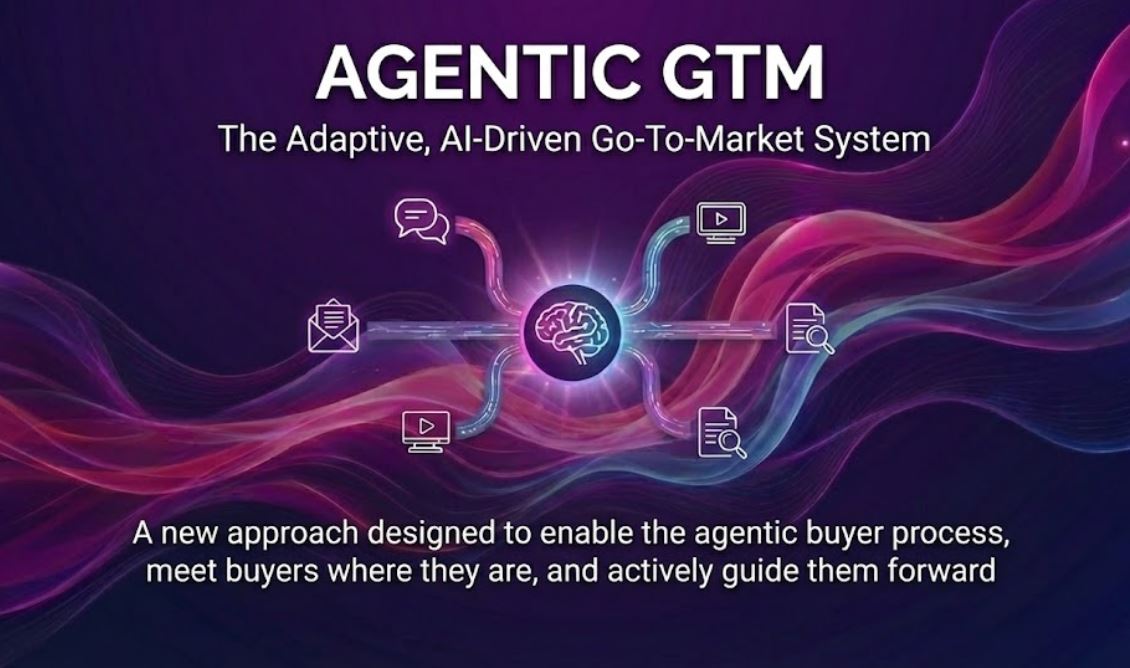
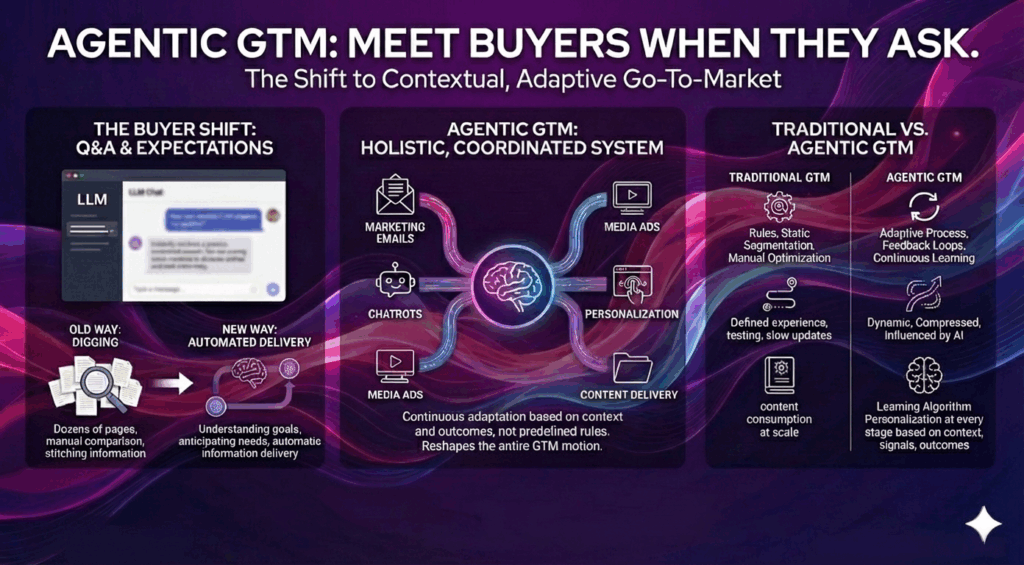
Buyers are now used to Q&A interactions in LLM chats, where they can ask highly specific questions and receive precise, contextual answers instantly. But the bigger shift isn’t just how they research—it’s their expectation that the work will be done for them. They don’t want to dig through dozens of pages, compare options manually, or stitch together the story on their own. They want an experience that understands what they’re trying to achieve, anticipates what they need next, and automatically delivers the right information to support their decision making process. That’s why GTM must evolve to Agentic GTM: an approach designed to enable the agentic buyer process, meet buyers where they are, and actively guide them forward—even when they move fast, stay anonymous, and leave fewer traditional intent signals.
Agentic GTM must reshape the entire go-to-market motion because buyers’ agentic expectations don’t stop at one touchpoint. They influence how you structure marketing emails, how chatbots respond, how personalization operates, how media ads are targeted, and how content is delivered across every channel. When buyers expect contextual answers everywhere, GTM can’t be a collection of disconnected tactics. It needs to operate as a coordinated, holistic system—one that continuously adapts based on context and outcomes, not just based on predefined rules.
Therefore Agentic GTM isn’t a new channel or another campaign framework. It’s a shift from running tactics to running an adaptive process. Traditional GTM is built on rules, static segmentation, and manual optimization: you define what should happen, build an experience, test variations, and update it over time. That model worked when the buyer journey moved more slowly and when marketers had more visibility into early-stage behavior.
But in an agentic world, we must assume the opposite. Buyer journeys are dynamic, compressed, and constantly influenced by AI interactions happening on and off your website. Instead of fixed logic, Agentic GTM relies on feedback loops that learn and improve as they go—personalizing the journey at every stage based on context, signals, and outcomes. That’s what makes it more powerful, but also more demanding: your company needs to consistently support accurate, contextual answers when buyers “ask” questions—either directly on your website, or indirectly through LLM conversations that shape how they understand your category, your competitors, and your brand.
The 3 Foundations of an Agentic Website
The website is becoming the most important surface in B2B—not only because it’s where buyers make decisions, but also because it’s where AI systems learn about your brand and solutions. LLM chats increasingly pull from public web content to form opinions, summarize your positioning, and answer buyer questions. That means your website doesn’t just power the on-site experience anymore. It supports the entire Agentic GTM motion, including how buyers understand your solution before they even land on your website.
But an agentic website goes far beyond adding a chatbot, serving personalized calls-to-action or testing a homepage message. It’s adaptive across the entire experience. Your website holds the most complete and authoritative information about your solution, and it’s often the only place where buyers can validate the details they need in the consideration stage—proof points, differentiation, product depth, integrations, pricing plans, and real-world use cases. In an agentic world, that information can’t sit passively. It needs to be activated.
The objective is to enable the website to support 1:1 buyer journeys at scale—not just by showing relevant content, but by continuously guiding each visitor with a best-next-action approach. Historically, delivering this level of personalization required significant manual effort to build and maintain, which made it difficult to scale beyond a few segments or use cases. Today, with AI and LLM-driven capabilities, that promise is finally achievable: websites can understand context in real time, adapt the journey dynamically, and move buyers forward with far less operational complexity.
That’s why an agentic website should behave like an intelligent seller. In the traditional model, the website is essentially a content library with a conversion layer. In the agentic model, the website becomes the orchestrator of the buyer journey—built to help buyers make decisions efficiently, confidently, and with minimal effort.
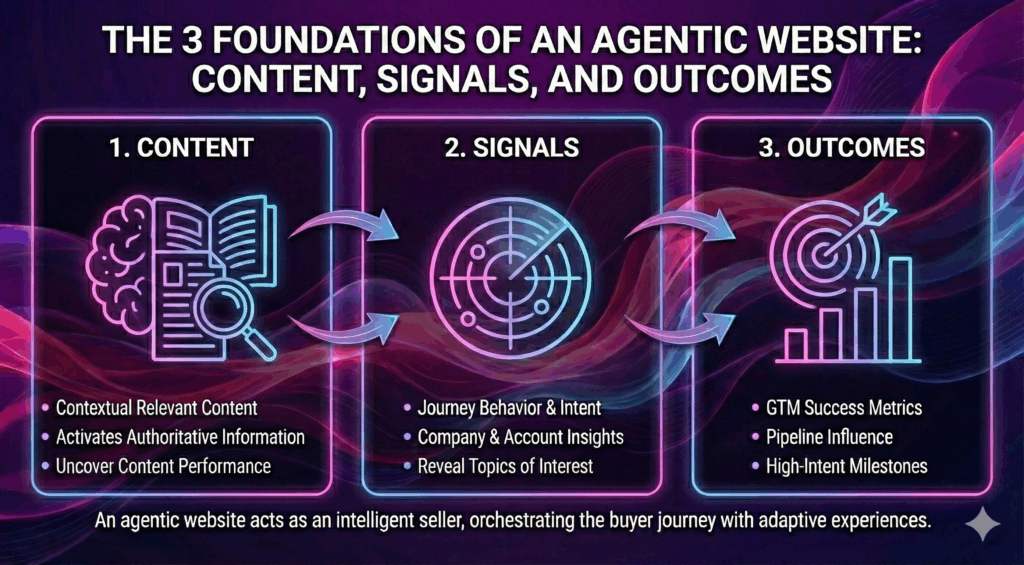
The ideal agentic website operates as if there is a dedicated agent for every visitor, guiding them through the most effective decision path based on who they are, what they care about, and where they are in their journey. But that only becomes possible when the website has a “brain” with ongoing access and interfaces to three foundations: content, signals, and outcomes. Content is not only the pages and assets you publish, but also an understanding of which piece performs best, which narratives work for different personas, and how to answer the questions that buyers actually ask. Signals provide the context—company attributes, account-level insights, journey behavior, and intent indicators that reveal what the visitor is trying to accomplish. Outcomes give the system its direction—metrics like account score, high-intent indicators, pipeline influence, and the milestones that define success for your GTM motion.
But the most fundamental layer is your content. An agentic website is only as effective as the content it can activate. If your content isn’t structured to deliver contextual, persona-specific answers for your target industries—especially for consideration-stage buyers—then the website can’t reliably guide decisions or move buyers forward. That’s why the first step in implementing an agentic website should be a readiness test focused on analyzing the content you already have.
Trendemon as an Agentic Website Platform
Our mission has always been to influence buyer journeys by turning B2B websites into active growth engines. But the shift to Agentic GTM raises the bar. It requires a platform that connects content, signals, and outcomes into a single, continuously learning engine—one that can orchestrate website journeys end-to-end without creating operational overhead.
As mentioned before, the foundation of agentic websites is content. Everything else—signals, orchestration, optimization, outcomes—depends on having the relevant information, and surfacing it to the right buyer at the right time. Trendemon empowers both ends:
- Content: Trendemon is designed to automatically analyze and understand your content – what topics it covers, which personas it serves, what stage of the journey it supports, and how it performs against real outcomes like pipeline impact. With that layer in place, the website can reliably activate the most relevant, top-performing content for each visitor and guide them toward the next best step.
- Signals and Outcomes: To make orchestration truly agentic, the platform needs continuous access to context. That’s why Trendemon supports deep integrations with CRM and Marketing Automation systems, along with additional intent and account-level signals from ABM platforms. With these inputs connected, the website can understand each visitor in real time and generate the most relevant experience to move them in their journey. Plus, measure the impact of the agentic motion on outcomes like pipeline and growth.
Click here to explore our agentic websites capabilities.
Rule-based tactics like CTAs, A/B tests, and static personalization can lift conversion rates, but they don’t create an agentic journey. Agentic experiences are fundamentally different: they are driven by feedback loops, optimized continuously, and designed to move buyers forward automatically—based on content, signals, and outcomes, not manual rules.
And in the agentic era, the impact extends beyond the website. The content and experiences you activate on-site increasingly shape how buyers understand your brand through LLM chats—often before they ever fill out a form or speak to sales.
Agentic GTM isn’t a distant future. It’s quickly becoming the standard for how modern buyers evaluate, decide, and engage—and agentic websites are how B2B teams keep up.