The “Agentic” Takeover: 2025 Data Reveals the End of the Traditional Buyer Journey

The year 2025 marks a definitive turning point in B2B marketing, a year where the traditional funnel fundamentally changed. Through extensive research covering data from 122M B2B websites journeys across multiple industries, we have identified a dramatic transformation driven by the widespread adoption of LLM chats. The research phase of the buyer journey has largely migrated off-site, taking place inside AI interfaces rather than on your website. The result is a paradox: while total website traffic is stagnating and engagement metrics are dropping, the buyers who do arrive are showing significantly higher intent. They are no longer exploring; they are considering. Here is what the data tells us about this new reality.
The Redistribution of Traffic Sources
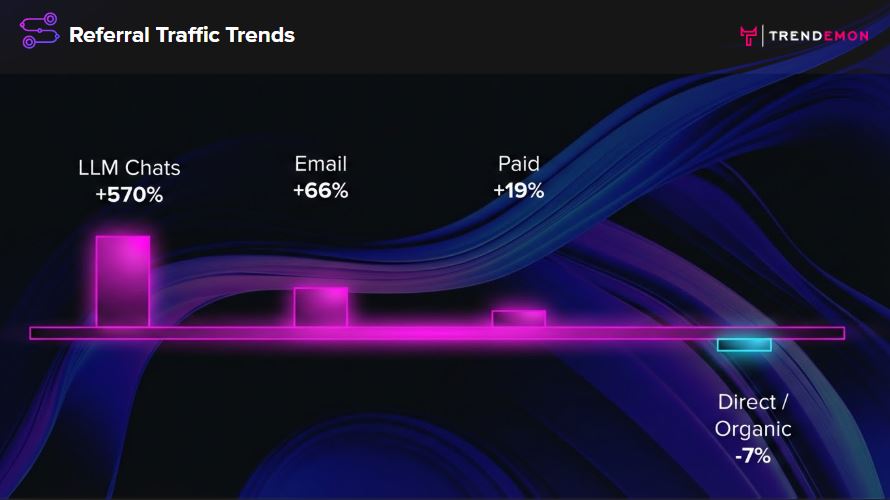
The most telling statistic of 2025 is the staggering +570% skyrocketing of traffic coming directly from LLM sources. While the total volume of accounts visiting websites remained mostly flat (+1%), the composition of that traffic has changed fundamentally. This massive surge in AI-referrals represents a new buyer behavior that is actively eating into historical SEO investments. Consequently, we see a -7% decrease in direct and organic traffic, a clear signal that the traditional ‘Google search to blog post’ motion is fading as buyers increasingly turn to AI for answers. To compensate for the loss of organic reach, companies have leaned heavily into outbound and advertising, driving a +66% increase in email traffic and a +19% increase in paid sources. Interestingly, not all paid channels are equal; LinkedIn paid traffic surged by +129%, while Google paid traffic actually decreased by -6%.
The bottom line is that the cost of traffic is higher – historical SEO investments are yielding diminishing returns as organic traffic declines, forcing a costly pivot to paid channels just to maintain volume. With acquisition costs rising, the pressure to be ruthlessly efficient has never been higher.
The Rise of the Anonymous Buyer
Despite the increase in paid efforts, our visibility into who is actually on the site is shrinking. We are seeing a continuing trend of increased anonymity. In 2024 you could identify at least one contact in 5.9% of visiting accounts. In 2025, that figure has dropped to 5.4%. This decrease signals that buyers are increasingly protective of their privacy and are conducting their due diligence in the shadows. They are reluctant to fill out forms or reveal their identity until they are absolutely ready to engage, making the “gate everything” strategy less effective than ever before.
The Declining Engagement of the Buying Group
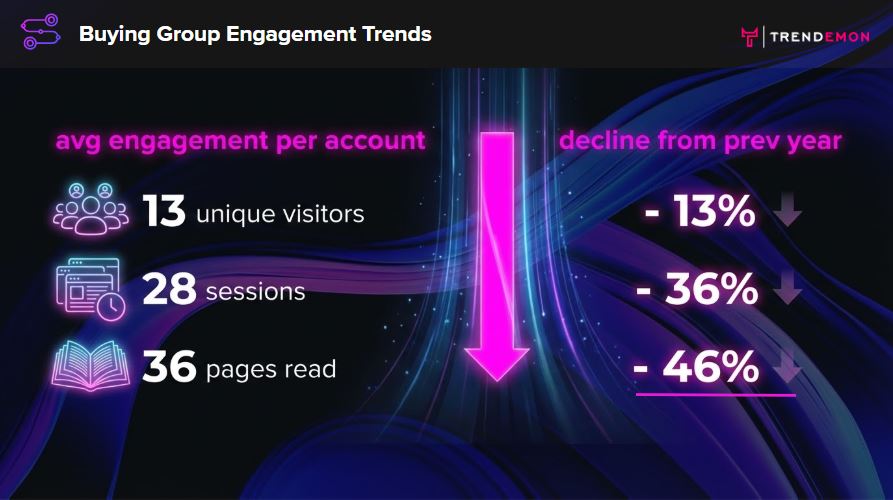
When we look at the activity of identified accounts that actually turn into deals, we see a buying group that is leaner and much more focused than in previous years. In 2025, the average account brought 13 unique visitors to the website, a -13% decline compared to 2024. But the drop in activity is even more pronounced: The average number of sessions per account fell to 28, representing a sharp -36% decrease year-over-year. Most strikingly, the depth of content consumption has been cut nearly in half: the average account read just 36 pages this year, a massive -46% drop from the 67 pages they consumed in 2024. This decline doesn’t signal a lack of interest; rather, it confirms that the heavy lifting of discovery and initial research is happening off-site.
Buyers are using LLMs to synthesize information before they ever click a link, so they aren’t skipping the awareness phase—they are simply completing it elsewhere. This means they arrive on your site pre-educated and ready to consume mid-funnel content to support their decision making process.
From AI Chats to Pipeline
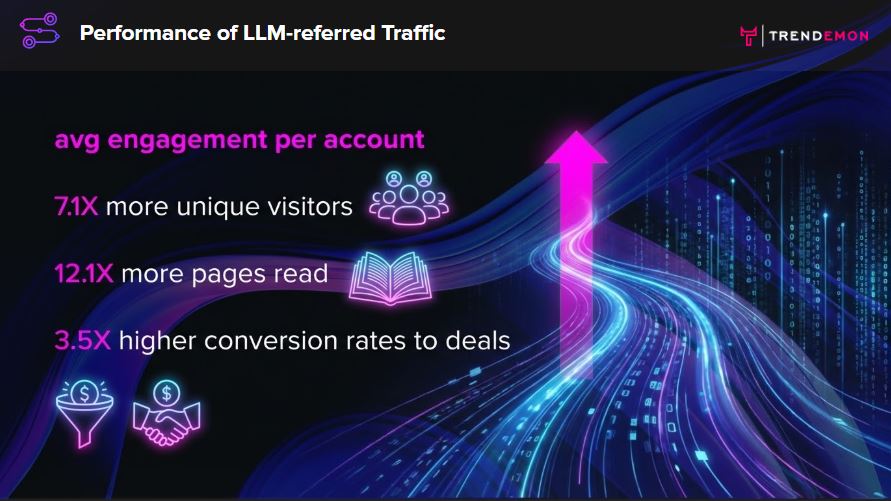
The quality of traffic coming from LLM sources is unmatched. These buyers are intensely engaged, bringing 7.1x more visitors and consuming 12.1x more content per account. This activity is not noise; it is revenue. Companies that touch an LLM source during their journey demonstrate a 3.5x higher conversion rate to deals. These are not casual browsers—they are highly motivated buyers using AI to validate your solution before they ever land on your site.
Why Conversion Rates Are Rising as Traffic Stalls
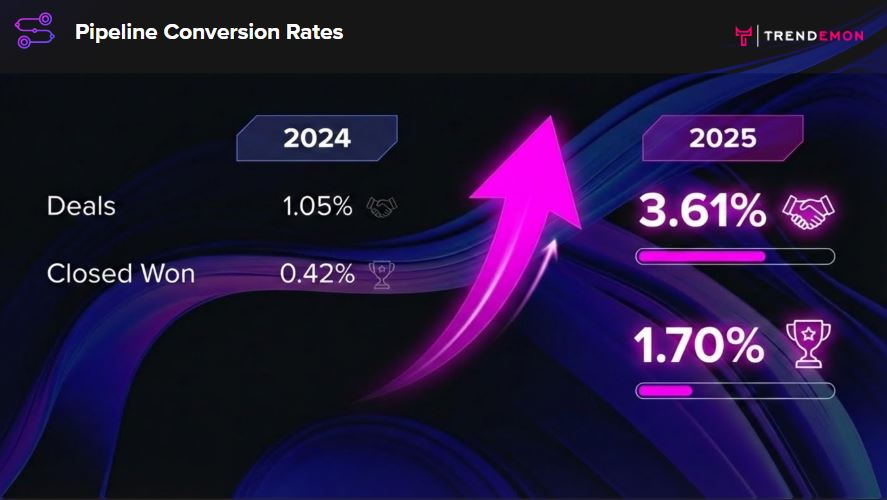
The most encouraging data from 2025 is the incredible efficiency of the pipeline. Despite—or perhaps because of—the stagnation in overall traffic, conversion rates have improved drastically. This spike is driven by a new dynamic: LLM chats act as a ruthlessly efficient filter. However, this filter acts as a double-edged sword. On one hand, it effectively screens out the “noise”—the students and casual browsers who were only looking for a quick definition or basic pricing and never intended to buy. But on the other hand, it means you may be losing legitimate opportunities simply because an LLM recommended a competitor over you, preventing those buyers from ever landing on your website. Those who do arrive are the ones who survived this cut. This “survival of the fittest” dynamic caused the conversion rate to deals to jump from 1.05% in 2024 to an impressive 3.61% in 2025. Even more critical for the bottom line, the conversion rate to Closed Won deals leaped from just 0.42% in 2024 to 1.70% in 2025. The data proves that while you are getting fewer “lookers,” the buyers who arrive are the ones ready to explore more deeply and purchase.
The Power of Contextual Experiences
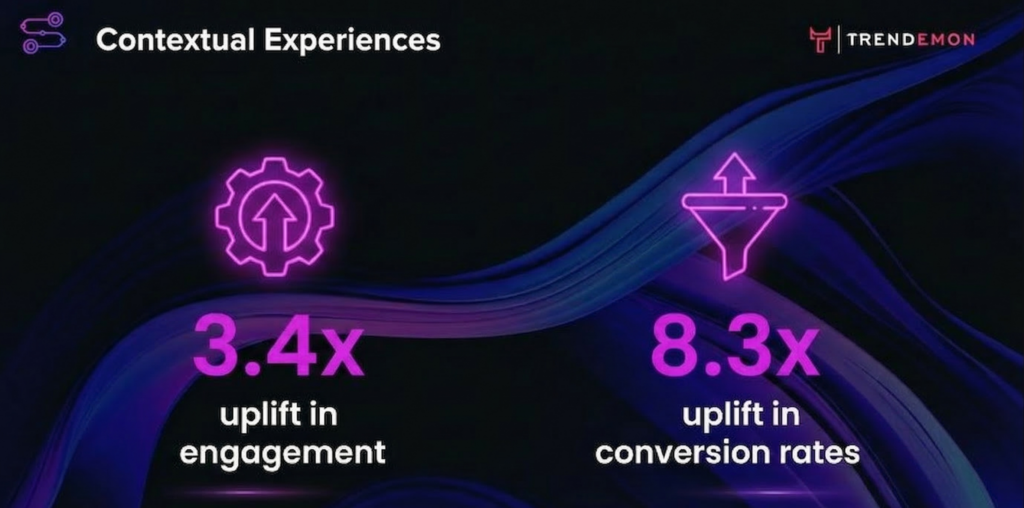
With attention spans shortening, the “one-size-fits-all” website is obsolete. Our data on Contextual Experiences—providing specific personalized answers, offers, and relevant paths rather than static content—shows massive performance gains. Implementing these contextual experiences resulted in a 3.4x uplift in engagement and a massive 8.3x uplift in conversion rates per month. This suggests that when you move away from forcing a visitor through a generic funnel and instead align with their specific context, the impact on your revenue is clear. In an era of high anonymity and low patience, context is the only lever left to pull.
So, why should you care about these numbers?
The data reveals the undeniable ‘smoking gun’ of the Agentic Takeover: buyers’ willingness to read content on your site has been slashed by nearly half. This isn’t just a metric; it is a fundamental behavioral shift from reading to asking. Buyers are no longer browsing dozens of pages to piece together information—they have already done that work off-site with an AI agent via LLM chats. They arrive on your website more educated, informed, and impatient than ever before. Because they have already done the ‘learning’ elsewhere, your website can no longer just be a library of static content. It must evolve into an Agentic Contextual Experience that aligns with where they are in their journey, providing the specific, high-level answers they need to finish the deal, rather than forcing them to browse through all of your content.