The AI Shift in B2B Products: From Operator to Strategic Architect
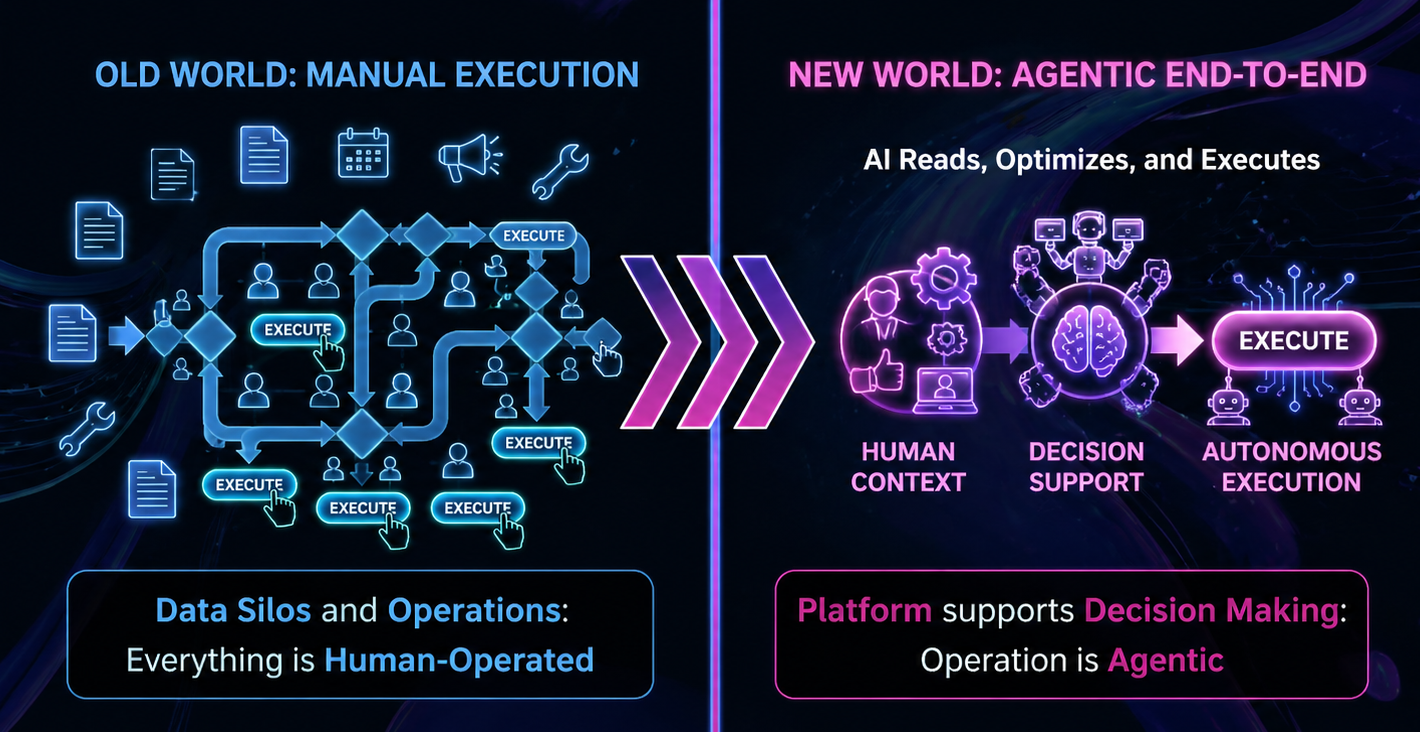
In the “Old World” of B2B, products were defined by data silos and manual operations. Whether it was Marketing Automation, CRM, or ABM platforms, software was a passive container. It held your data and provided tools to scale operations as workflows, but a human had to do every ounce of the heavy lifting to connect the dots. Every segment created, every email written, and every workflow mapped was the result of human configuration and effort spent.
Today, that world is fading. It is being replaced by platforms that don’t just store data and trigger workflows, but understand the context of the data and operations—and act upon them. These platforms support decision-making, requiring the human only to provide the initial context and final approval before going live.
The New Agentic World
In the new reality, AI is a commodity, but its application is transformative. B2B products are evolving from passive tools into active participants. Think of the transition we’ve seen with ChatGPT: when you use generative AI, you are no longer the writer laboring over every sentence; you are the editor, refining and guiding the output.
The same shift is happening in B2B platforms. We are moving away from manual operation toward a model where AI reads the data, understands its business impact, and executes tasks autonomously to improve your GTM motions. The platform is no longer just a place where work happens—it is the teammate doing the work for you.
The Human Role: From Operator to Architect
The modern software paradigm is built on a “New Stack” that combines Data and Operations with a third, critical ingredient: Business Context.
It is no longer enough for a system to store a target account list and trigger pre-set workflows. It needs to understand how this entire holistic motion impacts your business outcomes. It needs to grasp your GTM preferences—such as whether you are prioritizing one product over another this quarter, or if you are shifting focus from new customer acquisition to expansion within your existing enterprise base, and more. It needs to understand the big picture.
This changes the human role entirely. Your job is shifting from operational execution to defining policies and preferences while exercising judgment. Much like a high-level executive, you set the guardrails and define the strategy, while the AI handles the tactical execution. This isn’t just automation; it’s decision-support that removes the “grunt work” of daily optimization while keeping you firmly in the loop for high-level approvals.
Trendemon is your New GTM Co-Pilot
At Trendemon, we are building specifically for this B2B revolution. The complexity of modern buyer journeys—filled with fragmented ABM data and multifaceted buying committees—has made manual operation impossible to scale. This is why B2B software needs to evolve from a data and operations platform into a true GTM Co-pilot.
We are charting a path toward an agentic ecosystem designed not just to report on the past, but to actively support your future decision-making. In this vision, the human provides the high-level context—target audiences, business KPIs, and strategic priorities—while the technology acts as the engine that helps bring that strategy to life.
We are focused on bridging the gap between insight and action through two core pillars, aimed to shift the burden from the user to the system:
- Notifications to support decisions: Instead of digging through dashboards, your co-pilot is designed to surface the “signal” within the noise, alerting you on shifts in GTM performance before they become problems.
- From insights to action: Identifying a challenge and activating a solution happen in the same breath by automatically generating the “next best step”.
Trendemon’s mission is to redefine the relationship between marketers and their tech stack. We’re building a future where you stop managing tools and start leading outcomes.