The Decision Velocity: From Content Libraries to Answer Engines

In the complex world of B2B commerce, the “Buyer Journey” is often discussed in terms of clicks, stages, and touchpoints. But fundamentally, a buying journey is a decision-making process. It is a sequence of micro-conclusions—about budget, technical fit, security, and trust—that eventually culminate in a final “Yes.”For a decision to be made, a conclusion must be reached. And to reach a conclusion, information must be processed. This relationship between Information, Processing, and Decision is where the B2B Go-To-Market strategy is currently undergoing its most radical transformation.
Phase 1: The Era of Asymmetry (The Seller-Led Journey)
Historically, the seller held the keys to the kingdom. Pricing, technical specifications, and implementation details were proprietary information locked behind the gate of a sales representative.
The buyer’s decision-making process was slow because access to information was rationed. The seller acted as the guide, dripping information slowly. While inefficient, this model ensured that when information was given, it was contextualized. The seller bridged the gap between raw data and the buyer’s conclusion.
Phase 2: The Era of Cognitive Overload (The Content-Led Journey)
Then came the digital explosion. We moved from information scarcity to information ubiquity. Marketing teams transformed into publishing houses, flooding the market with whitepapers, blogs, case studies, and reports.
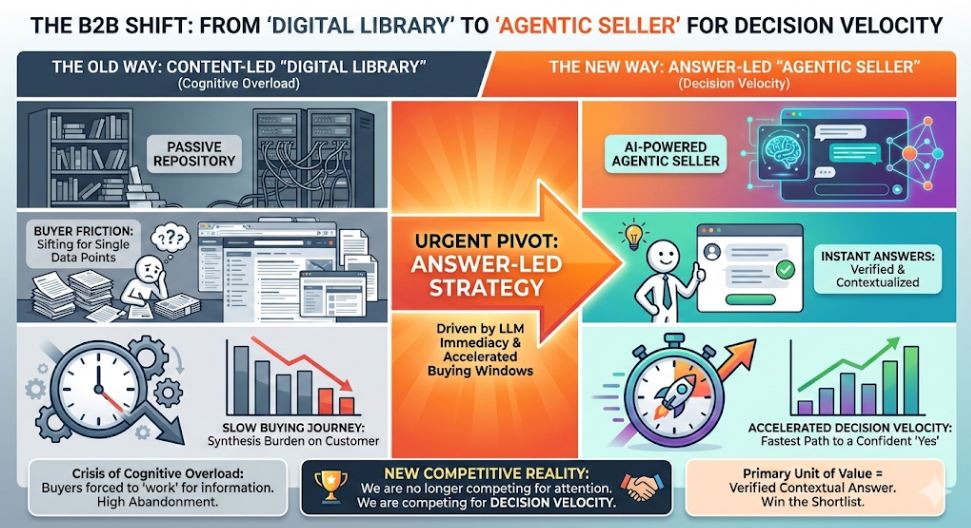
We built “Resource Centers”—vast digital libraries—and told buyers to help themselves. We shifted the burden of processing onto the buyer. We effectively said: “Here is a 40-page PDF. You read it, you understand it, you synthesize it, and you come to a conclusion”. In this environment, the friction shifted from access to analysis. For a modern buying committee to reach a decision, they had to consume massive amounts of unstructured content. The “Library Website” became a bottleneck, slowing down decision velocity by forcing buyers to do the heavy lifting of connecting the dots.
Phase 3: The Era of Answers (The Answer-Led Journey)
Today, we have entered the age of the Large Language Model (LLM). This technology has fundamentally changed buyer expectations because it solves the processing problem.
Buyers no longer want to search; they want to find. They no longer want to read; they want to know. LLMs have the unique ability to ingest vast amounts of data and instantaneously synthesize it into a contextualized conclusion—an Answer.
In this new reality, the fundamental unit of value is no longer the “Content Asset”; it is the “Contextual Answer.”
The race between competitors has shifted. It is no longer about who has the most content, but who can accelerate the buyer’s time-to-conclusion. If a buyer lands on your site with a specific question about API latency or enterprise security, and they have to browse three pages to find it, you have already lost. They will retreat to a competitor (or a public AI engine) that gives them the answer instantly.
The New Mandate: The Website as an Agentic Seller
This shift forces an identity crisis for the corporate website. The “Static Library” model is obsolete.
The modern B2B website must evolve into an Agentic Seller. It must possess a dual capability:
- The Repository: It must still house the deep, authoritative information and technical documentation.
- The Synthesizer: It must layer an intelligent, active interface on top of that data to serve the visitor.
An Agentic Seller does not wait to be read. It identifies the visitor through intent signals, understands their context, and proactively answers the questions they haven’t even fully formulated yet. It guides the journey not by offering more to read, but by offering conclusions that aid decision-making.
In the Answer-Led era, we are not competing for attention; we are competing for clarity. The winner will not be the company that produces the most noise, but the company that provides the fastest, most accurate path to a decision.